Speculative design did become a big curiosity since the beginning of this course. It holds a beautiful mixture of design skills used to portray traits or behaviours in a highly conceptual manner. It does remember me at times of futurist representations used in movies or magazines in the nineties.
Bernd Hopfengaertner, Belief Systems, 2009
Facial micro expressions last less than a second and are almost impossible to control. They are hard wired to the emotional activity in the brain which can be easily captured using specially developed technological devices. Free will is now in question as the science exposes decision-making as an emotional process rather than a rational one. This ability to read emotions technologically result in a society obsessed with their emotional reactions. Emotions, convictions and beliefs which usually remain hidden, now become a public matter. “Belief systems” is a video scenario about a society that responds to the challenges of modern neuroscience by embracing these technological possibilities to read, evaluate and alter peoples behaviours and emotions.
I came across this conceptual work during my reading about speculative design. Bernd Hopfenganter is a Berlin based artist that uses speculative methods in his works. I was thrilled about his vision and about the means he portrays truths on which speculations about the future are created. Most surely deeply inspirational.
“By imagining the possible, the speculative, the non-existent (to quote an old industrial band: what is, is, what is not, is possible), Art and Design can contribute to a broader discourse in a way that is not accessible by purely analytical means. I’m interested in Design as an interdisciplinary intermediary, placed in-between natural science, engineering, cultural and media theory and everyday-life”
Speculative Everything: Design, Fiction, and Social Dreaming
Walter Pichler, TV Helmet (Portable Living Room), 1967. Photograph by georg Mladek.
As Fredric Jameson famously remarked, it is now easier for us to imagine the end of the world than an alternative to capitalism. Yet alternatives are exactly what we need. We need to dream new dreams for the twenty-first century as those of the twentieth century rapidly fade. But what role can design play? When people think of design, most believe it is about problem solving. Even the more expressive forms of design are about solving aesthetic problems. Faced with huge challenges such as overpopulation, water shortages, and climate change, designers feel an overpowering urge to work together to fix them, as though they can be broken down, quantified, and solved. Design’s inherent optimism leaves no alternative but it is becoming clear that many of the challenges we face today are unfixable and that the only way to overcome them is by changing our values, beliefs, attitudes, and behaviour. Although essential most of the time, design’s inbuilt optimism can greatly complicate things, first, as a form of denial that the problems we face are more serious than they appear, and second, by channeling energy and resources into fiddling with the world out there rather than the ideas and attitudes inside our heads that shape the world out there. Rather than giving up altogether, though, there are other possibilities for design: one is to use design as a means of speculating how things could be—speculative design. This form of design thrives on imagination and aims to open up new perspectives on what are sometimes called wicked problems, to create spaces for discussion and debate about alternative ways of being, and to inspire and encourage people’s imaginations to flow freely. Design speculations can act as a catalyst for collectively redefining our relationship to reality.
Keywords: alternatives, dream a new dream, design as problem solving, design as a way to speculate how things could be, new perspectives, alternative ways, design speculations as a catalyst
Four different dimension of speculative design:
Probable
Plausible
Possible
Preferable
Designing for how things could be, conceptual design: “Patrick Stevenson Keating’s The Quantum Parallelograph (2011) is a public engagement prop exploring ideas about quantum physics and multiverses by finding and printing out online information from a user’s “parallel life.” It uses abstraction along with generic technical references to suggest a strange technological device. It is clearly a prop but it sets to work on the imagination very quickly.”
The first conceptual artist, Marchel Duchamp, highlights core features of a conceptual work:
10. Ideas can be works of art; they are in a chain of development that may eventually find some form. All ideas need not be made physical.
13. A work of art may be understood as a conductor from the artist’s mind to the viewer’s. But it may never reach the viewer, or it may never leave the artist’s mind.
17. All ideas are art if they are concerned with art and fall within the conventions of art.
28. once the idea of the piece is established in the artist’s mind and the final form is decided, the process is carried out blindly. There are many side effects that the artist cannot imagine. These may be used as ideas for new works.
31. If an artist uses the same form in a group of works, and changes the material, one would assume the artist’s concept involved the material.
9.The concept and idea are different. The former implies a general direction while the latter is the component. Ideas implement the concept.
Conceptual design as a form of critique:
n. The term critical design coined in the mid nineties at Computer Related Design Research Studio at the Royal College of Art
d. “critical design uses speculative design proposals to challenge narrow assumptions, preconceptions, and givens about the role products play in everyday life.”
Critical design =/ Affirmative design
testimonials of what could be offering alternatives that highlight weaknesses within existing normality involves critical thinking, being skeptical, all good critical design offers an alternative
Prior to the ideation sessions, I started to research a bit about indoor climate. I remembered about this principle used in contemporary interior design – biophilic design and I wanted to go more in-depth in the subject. The main philosophy behind it talks about connecting the user with the natural environment as much as possible through direct or indirect means and the right spatial decisions. I didn’t quite see at this point how I could use this for our shape changing object, but I promised myself to keep it in mind.
We did around three ideation sessions of 15 minutes, after which we each shared our ideas for the project. The following ideas were ideated during these sessions:
an object similar to the Pokemon go that would open up and create a different shape, its function being used mainly in self entertainment;
curtains that can be controlled – light intensity wise;
a bench that decreases its size in order to make people sitting on it become closer, an idea that would fit in the category of designing for social interaction;
a painting that changes its initial shapes into three different parts and rotates according to your body movement;
shape-changing textiles: a jacket that is lightweight, but you can control its size depending on the temperature; an object used for nature expeditions where weather can change very drastically from one moment to the other;
a cube that reacts to sound, heat or light and changes its shape according to the indoor climate levels (db, temperature, light intensity);
We agreed fully that the painting idea was one of the best from these sessions and we started to discuss about it decided to choose this for our video project.
Third session was pretty difficult as we each had our own questions about the whole project. At times, very below the surface questions as “what is a shape changing object”, is rotation considered as a change in its shape or does an object have to completely change its initial shape in order to be considered in this category. Following these types of questions, we went more in depth regarding the actual technicalities of what our project implies. First of all, a physical object that changes its shapes, the visual part containing some artwork and finally the interactivity part where the object reacts to your relation to it. After we established that the rotation system will not count as shape changing, I have came up with the idea of one single object that bends its screen and incorporates patterns from nature. This should solve our interactive shape changing ideation quest after these multiple discussions.
Learning about computational creativity was one of the main reasons why I decided to started the studies in Interaction Design. It is such an unexplored area and generative art can reach immersive levels never imagined before. Having this week dedicated to Processing experimentation is surely a personal delight.
David Cuartialles hold a guided exercise on how to creatively use Processing and I was happy I was able to follow actively and solve the little issues on my way successfully. At this point I really felt my knowledge built in Programming I serving me as a support for using this software. Even though the differences between Java/Processing and JavaScript are very high, I do feel it offers a starting point if you wish to learn this computational environment.
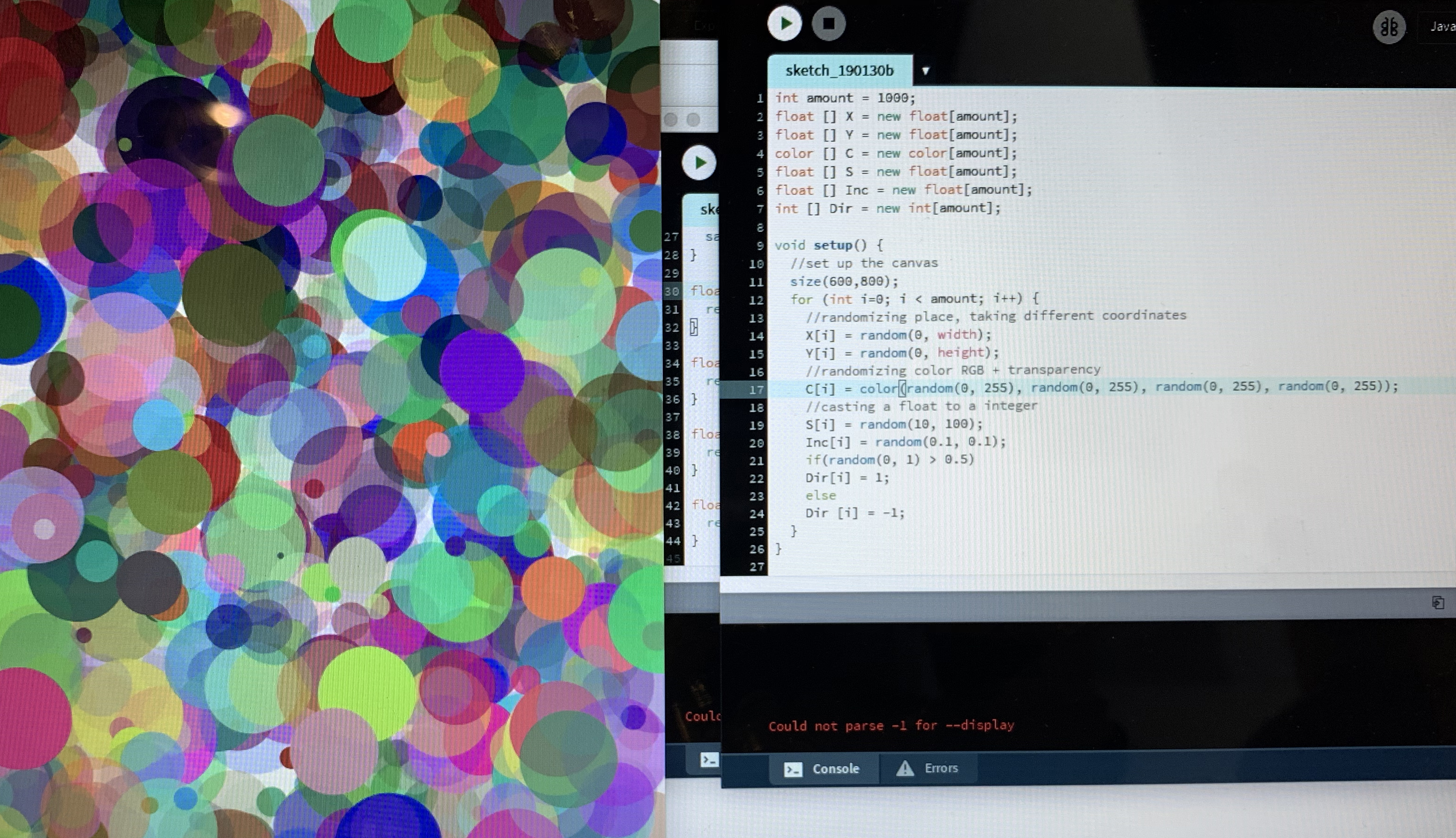
We did have fun and we also did built a timer telling us how many seconds and minutes are left until we fry. We also created some cool randomly generated circles that implied coding a lot of arrays and variables, but the result was nice and fun I told myself.


 Reflections of an Interaction Designer