Image

Combining physical and digital prototyping

While Monica and Cathrine are prototyping straws from different graphic papers, I am organising the template of the website according to the wireframes. We have decided on a classical approach: landing page with an about section and some design insights, the shop page that displays each straw with the option of quick view or view full product page and a testimonials page.

I have received the photography of all our physical products and I am editing each photo for brightness, cutting background and small details to the scope of making them look unified.

Concluding Physical Prototyping II


A giant banner that asked “Now that we can do anything, what will we do?” was the greeting point at the exhibition organised by the Institute without Boundaries in Chicago’s Museum of Contemporary Art. A big reflection point in every designer’s practice when the perspective moves from the world of design towards the design of the world. At first sight, it might appear as one and the same thing, but during thorough design processes, below the surface aspects start to come alive. The design thinking phases include empathise, define, ideate, prototype and test and if last semester we had the opportunity to experience the former, this course gave us the chance to immerse in the latter. As a reflection note, prior to this work I considered the prototyping stage of low difficulty and maybe the point where experimentation, creativity and freedom come to play. However, working closely with the ideation-prototyping-testing methods made me realise they are most probably the most challenging phases of taking a design out to life.

We decided to work on the context of addressable light for public spaces and more specifically how to use light interaction as a method to bring a more playful and warmer feeling in unrevised urban locations. We ideated using open discussions, mood boards and sketching. We came to the conclusion that we are to a certain extent already familiar with the aspects of the situation as we experience them in our everyday life. We set out more than five possible solutions and we carried out low-fi prototyping and first user tests. Effortless, almost as therewas no new implementation whatsoever, was one of the main insights we got at Dalaplan’sunderpass in Malmo. People were walking busy, not caring about tiles on the sidewalk or poles that light up. As they also admitted in interviews and surveys, they do not want to be in charge of extra actions or new interactions in this context. We used this as the main point in the following prototyping sessions. Nevertheless, I might say that due to the fact that we started with very low-fi prototypes, the overall process was one of slow advancement to real insightsand more polished solutions. Statements such as “it is definitely playful” and “I would never get to where I’m going, I would have too much fun” were concluded out of our last user tests, validating the fact that we did manage to bring the playful aspect alive in our prototypes.

Empirical data was the pillar of our main prototypes, assessing in an analytical way observations and statements that were made in our initial design research, in order to conceptualise our goal
for user values. In this way, I would say that the direct or indirect engagement with the users during our tests were used in order to validate or invalidate our assumptions made during ideation. Aspects such as discomfort in dark spaces and the realistic effects of light in public spaces were approved by users, whereas aspects such as active involvement and additional interaction with the space were not fully rejected, but were to some extent questioned by the majority of people.

The designer’s assumptions and decisions made during ideation and prototyping sessions maycome out with totally different output during user tests. This is one of the main aspects I can outline after these four weeks. Secondly, low-fi prototyping has an inherent lack of realism, but do bring about insights that you can build upon. And most important, prototypes are the bridge between the immaterial and the material, the point where your design will work or will fail. Lastly, it is definitely a different perspective when you design for the world as in opposite of experiencing design.

References

  1. Weinberg, L. (2007). Massive Change: The Future of Global Design. Mit Press Journals, 23(4). Retrieved fromhttps://www.mitpressjournals.org/doi/abs/10.1162/desi.2007.23.4.86?journalCode=desi.
  2. Dam, R., & Siang, T. (2018). Stage 4 in the Design Thinking Process: Prototype. Retrieved from https://www.interaction-design.org/literature/article/stage-4-in-the-design-thinking-process-prototype
  3. Buchenau, M. & Suri, J.F. (2000). Experience Prototyping. DIS ‘00 Proceedings of the 3rdconference on Designing interactive systems: processes, methods, and techniques

Image Reference

1. Zack, M. (2011). Black and White Rule [Digital image]. Retrieved from https://www.artsy.net/artwork/maya-zack-black-and-white-rule

Concluding Physical Prototyping

Final essay below:

Over the last four weeks, we have been introduced to physical prototyping in connection to different tools such as computational development and digital media. If previously, we have been faced with the challenge of creating low-fidelity prototypes in our design processes, in this course we had the chance to go more in depth of what it actually means to take our idea into physicality, how to experiment with different materials and mediums and how to successfully distribute the functionalities of the object in question, in order to obtain a holistic view of the project.

What do prototypes prototype represented the main challenge in all our experiments, I believe. And if we started this with simple materials such as cardboard and copper, we did reach the level of having to design and plan a prototype using well established video content. The wonders of Arduino as a computational environment used in connection to basic crafting skills took us to a new extent and challenged us as designers to see new possibilities. Creating an external controller and connecting it to Arduino or Processing programming language represented for me a high point of interest in this course. Following, ideation sessions and video production planning over how to transmit in the best ways the user values of an interactive shape changing object represented the real challenge of these four weeks of instruction.

After the completion of these assignments, I am really able to draw a line and question what does it actually mean to transform your idea into a physical object. As I have been faced with big question marks on how to fully integrate all features into a tangible prototype, I can draw on this many lessons. First of all, simple thinking will never fail you. Initially, when trying to create a version of our shape changing interactive artwork, I would consider building up a frame from a solid material with a white canvas that bends on the edges and on which a visual expression is projected and programmed to react to your body movement. I have discovered that prototyping does not work this way. In a project where very different and complex features are to be integrated, it is a must that you first experience with each one of them individually. There is no doubt in the advantages of experimenting with one feature transposed into different physical forms and testing these to their biggest extent. Only after understanding each one of these in depth, you are able to meet the final challenge of connecting them in order to achieve a qualitative and functional prototype. Second of all, never underestimate the powers of simple materials. As experienced in our first challenge, tools such as paper and cardboard will really help you gain some valuable insights of what it actually means to interact with your object, exactly as Houde and Hill defines this experience as “the look and feel” of the object. And most of the times, this feel will hold the most valuable lessons in the design process.

The biggest milestones in prototyping experiences are represented by first understanding the person you are designing for, the existing situation of the industry your design is about to be placed into, the need of design exploration of your idea and how to successfully communicate these to your audience, guidelines formulated by Buchenau and Suri. When faced with limited resources and only two weeks of time span, I was faced with the challenge of having to find the balance between all of these aspects. Which detail needed most attention, was one of my main questions. As an end assessment, I can conclude that we spent too much time in ideation sessions, trying to come up with the perfect working system for our object and getting ourselves lost in below the surface questions that will not serve the final goal of the task. Even though, we were at all times aware that this is a complex object, we did chose to take the challenge and make the most out of it. In this way, I did enjoy the process and it was pretty awarding to see a final product at the end of our hard work.

With little prior knowledge of video as a communication medium, I did discover some new and interesting softwares that sustain your work in the same means static digital design does. It is really fascinating how the combination of wording, audio and imagery can transmit your idea through triggering different types of feeling in the viewer. Our video prototype mostly triggered confusion in the majority of its viewers, something that I was mostly concerned about when carrying out the video editing tasks. In our video prototyping sessions, we chose to separate everything and showcase the main qualities of the object: shape, motion and interactivity and film as such representational video of our experimentation with the object itself.

This course offered me the opportunity of experimenting with the innovative ability of an object to change its form and transform itself into an immersive experience. Even though we are talking of an art object or simply of a drinking cup, it represents in an abstract way the new thinking designers should relate to. We are no longer constrained to technical limitations that will make us see objects as static and singled use and it is our duty to continue this process and discover new ways of creating. I keep this project in the archive of things I would like to gain more knowledge on and I do hope that through constant research I will be able to successfully transcend our idea in a fully functional prototype.
Lecture I: What do prototypes prototype?

The lecture on design philosophy regarding the working means with prototyping as a way of transforming your idea into a physical object was the first of the third lectures to follow. We discussed in depth of what it actually means to build, use materials and get valuable insights from each test. As one of the fundamental activities of a designer, it is highly needed to understand the principles behind what does a prototype implies. 

Discussing with my classmate over Valentine’s definition of a prototype, we did agree that it behaves as a teacher or a guide in your design process, it is the most valuable tool in order to concretise ideas and test them in real time. It is indeed a iterative process where failing and succeeding hold valuable lessons in order to achieve your final goal. Last, but not least we did agree that certainty is the aspect that will always miss. It is impossible to be fully confident of the first version of your prototype as this process requires that the “individual’s imaginations is tenaciously explored, tested, broken and rebuilt”. It is the moment where your confidence will be challenged and your wisdom will be your most valuable tool. 

The main knowledge behind this lessons is that we as designers must understand the situation we are designing for, the concept and the materials. As such we will be able to face the issues with lesser difficulty. 

I value book knowledge highly and I give its spot in my design practice, but throughout the talk I kept thinking that this is such a complex situation where issues that we can not yet imagine will come across and in those moments we need real life wisdom and actual prototyping practice in order to be successful. I told myself that I should not underestimate the insights from people that have worked with these methods before, but I should nevertheless exercise this as much as possible in order to create my own working method and to develop the thinking that will adjust my mind patterns in the best of ways. 

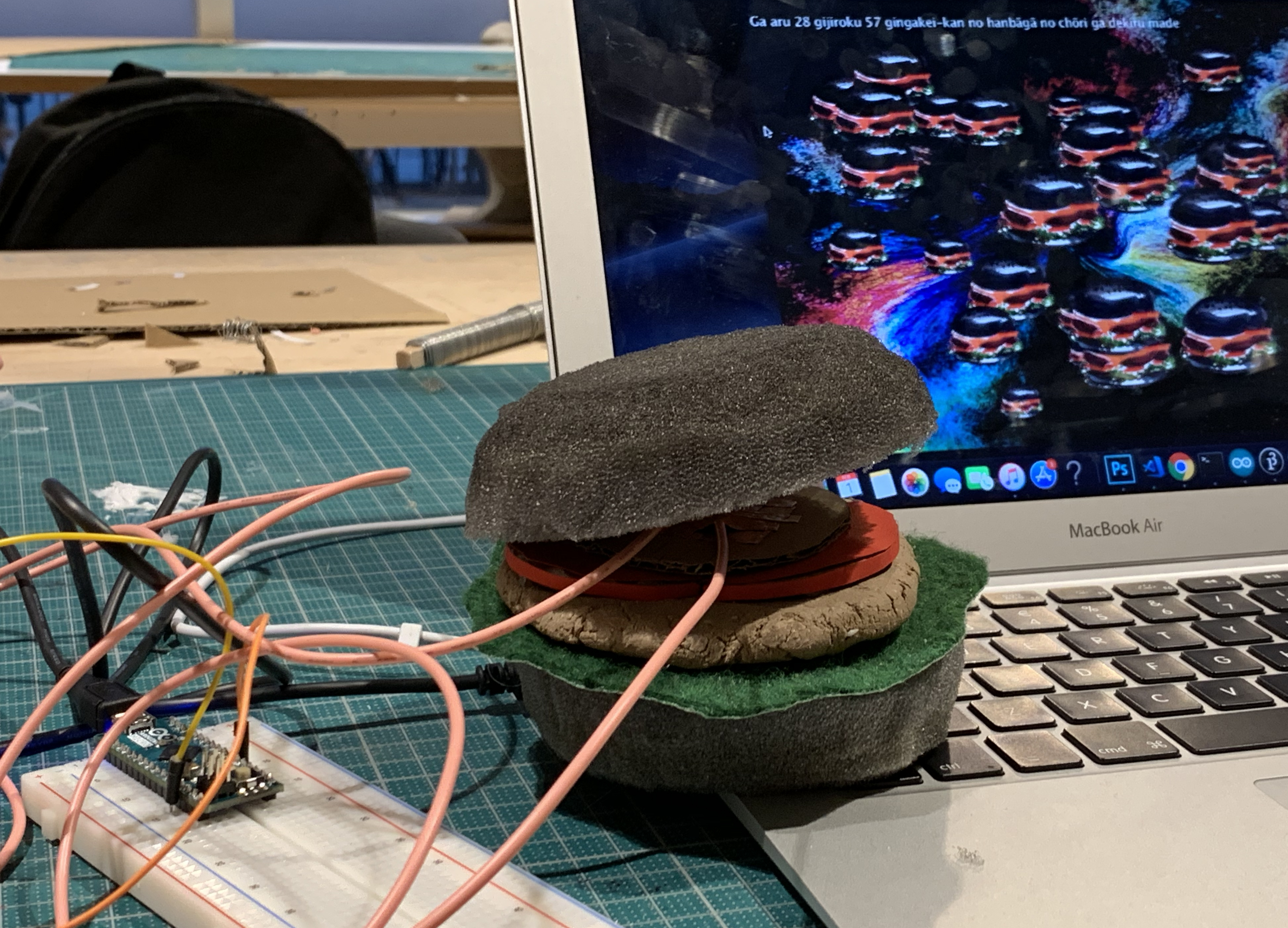
Intergalactic Burger

Group theme: burger

Challenge: build a physical prototyping that will react to a Processing visualisation 

Three hours well spent on how to get more in depth with Processing and David was very helpful in assisting our group with the Processing code. While my team mates were building the physical burger controller, I did took the task of coding. I learned how to load one static image as a background and one float image and afterwards how to code this image as a an array that will react to our controller. It was pretty fun, but our subject was trivial. Therefore, our project resulted in a trivial, only for fun work.