It was highly interesting to see how you can use creative coding for working with Adobe XD. I did experiment with the tool before and I also worked with different plugins and UI kits. However, it was my first time looking into ways of creating my own.
And who doesn’t like when your work gets automated and repeated tasks are solved quickly and in a beautiful manner?
Practice
I experimented with some available plugins and I changed some parameters to my own liking. We did get the suggestion of creating our own for the sake of practice and it is on my to do list by the end of this course.
Ubiquitous and pervasive computing come out as concepts that define my direct understanding of the digitalization of all sectors into one unified environment. This constant access to information and computational capabilities create in design an openness never before seen. “Now that we can do everything, what will we do?” is the question raised by the Institute without Boundaries at an exhibition in Chicago’s Museum of Contemporary Art and a perspective that I, as a designer, startedto consider during the past semester. Programming integrated into physical prototyping techniques creates depth, I believe, and it does bring about a new way of design thinking. Interactive design becomes an area where everything is possible as long as the skills at hand come into place with your artefact’s goals.
We decided to work on the context of addressable light for public spaces and more specifically how to use light interaction as a method to add a more playful and warmer feeling in unrevised urban locations. We carried out ideation and physical prototyping sessions and we integrated the programming components in order to advance our initial low-fi prototypes. Needless to say, I had major difficulties to connect all pieces of knowledge in a structured way of thinking, aspect that created for myself a slow development during the last phase of the project. We started out by experimenting with different Arduino sketches that were related to our project such as a series of colors triggered on an RGB led pin, on and off buttons, a light show on six different led pins and a proximity sensor that detects the distance between itself and a given external point. The missing components at this point were the setup of the serial bridge communication with or without Json and the manipulation of the afterwards received data. As an isolated element, working with Node and setting up the bridge communication between the browser and Arduino I found little troublesome as all tutorials in class gave me a clear understanding. However, I did have difficulties in adapting this to our context and prototypes and progress in the next phase of working with the data. At the end of the process, we created a main prototype that consisted of a GUI that communicated with our Arduino and can be manipulated from both places. As a reflection on the overall process, I believe that when I reached the point of understanding of where I could manipulate the data, I ran out of time in order to experiment more with it.
Interactive artefacts present the uppermost challenge of developing desired behaviors that arestrongly connected to the designer’s ability to code. To state that these programming techniquesare the barrier to whereas your design will bring about a new, innovative perspective feels almost common sense. I do feel that I was highly limited by my own capabilities when trying to bring an artefact to new positions, but at the same time this project offered me new knowledge on what it is possible. Controlling light or physical movement data and transforming all this information in a new layer that I, at this point, in a practice perspective, could place it mostly in the analytical area, brought about new colors. Moreover, it was highly interesting to discover this connectivity nest between all of our devices and how designers can retrieve or use these sources in order to create new types of experiences and interactions. I was aware of the projects that used our phone sensors and it was definitely captivating to work closer with the possibilities of it. Last, but not least I highly agree on the notion outlined by Weiser that ubiquitous computing should exist as a resource and not as an overwhelming aspect of our everyday life. In this context, I did reflect on what can be done, but at the same time what is necessary. Creative thinking can bring about unlimited concepts and in our ideation processes we did, at times, went over the convenience and usefulness area, all of this resulting in unneeded and unwanted interactions by the regular user, but I do outline this as a major insight I gained during this design practice.
References
Weinberg, L. (2007). Massive Change: The Future of Global Design. Mit Press Journals, 23(4). Retrieved fromhttps://www.mitpressjournals.org/doi/abs/10.1162/desi.2007.23.4.86?journalCode=desi.
Abowd, G. D., & Mynatt, E. D. (2000). Charting past, present, and future research in ubiquitouscomputing. ACM Transactions on Computer-Human Interaction (TOCHI) – Special Issue on Human- computer Interaction in the New Millennium, Part 1, 7(1), 29-58. doi:10.1145/344949.344988
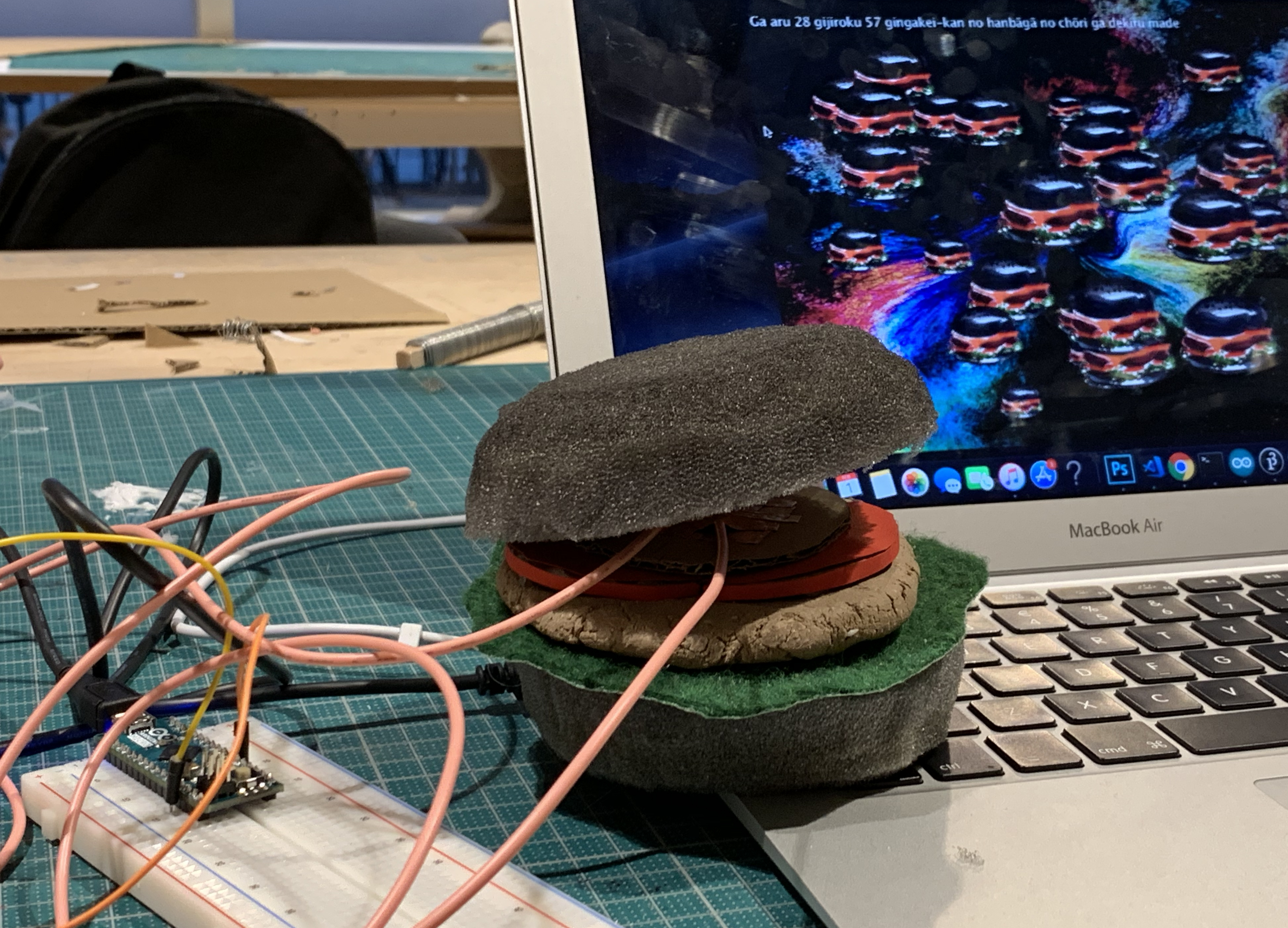
Challenge: build a physical prototyping that will react to a Processing visualisation
Three hours well spent on how to get more in depth with Processing and David was very helpful in assisting our group with the Processing code. While my team mates were building the physical burger controller, I did took the task of coding. I learned how to load one static image as a background and one float image and afterwards how to code this image as a an array that will react to our controller. It was pretty fun, but our subject was trivial. Therefore, our project resulted in a trivial, only for fun work.
Learning about computational creativity was one of the main reasons why I decided to started the studies in Interaction Design. It is such an unexplored area and generative art can reach immersive levels never imagined before. Having this week dedicated to Processing experimentation is surely a personal delight.
David Cuartialles hold a guided exercise on how to creatively use Processing and I was happy I was able to follow actively and solve the little issues on my way successfully. At this point I really felt my knowledge built in Programming I serving me as a support for using this software. Even though the differences between Java/Processing and JavaScript are very high, I do feel it offers a starting point if you wish to learn this computational environment.
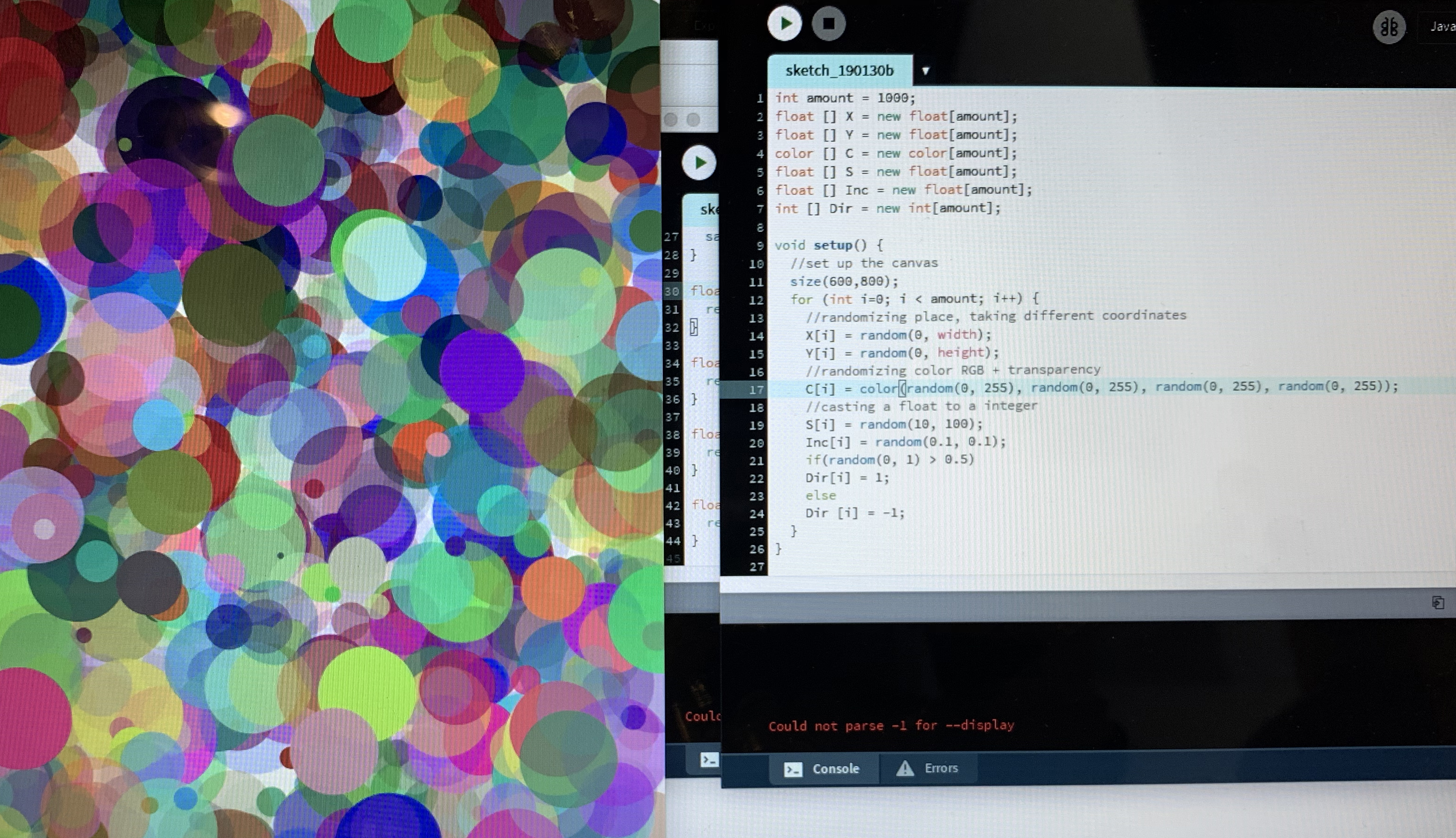
We did have fun and we also did built a timer telling us how many seconds and minutes are left until we fry. We also created some cool randomly generated circles that implied coding a lot of arrays and variables, but the result was nice and fun I told myself.


 Reflections of an Interaction Designer