More ideation

Prior to the ideation sessions, I started to research a bit about indoor climate. I remembered about this principle used in contemporary interior design – biophilic design and I wanted to go more in-depth in the subject. The main philosophy behind it talks about connecting the user with the natural environment as much as possible through direct or indirect means and the right spatial decisions. I didn’t quite see at this point how I could use this for our shape changing object, but I promised myself to keep it in mind. 

We did around three ideation sessions of 15 minutes, after which we each shared our ideas for the project. The following ideas were ideated during these sessions: 

  • an object similar to the Pokemon go that would open up and create a different shape, its function being used mainly in self entertainment;
  • curtains that can be controlled – light intensity wise; 
  • a bench that decreases its size in order to make people sitting on it become closer, an idea that would fit in the category of designing for social interaction; 
  • a painting that changes its initial shapes into three different parts and rotates according to your body movement; 
  • shape-changing textiles: a jacket that is lightweight, but you can control its size depending on the temperature; an object used for nature expeditions where weather can change very drastically from one moment to the other; 
  • a cube that reacts to sound, heat or light and changes its shape according to the indoor climate levels (db, temperature, light intensity); 

We agreed fully that the painting idea was one of the best from these sessions and we started to discuss about it decided to choose this for our video project. 

Third session was pretty difficult as we each had our own questions about the whole project. At times, very below the surface questions as “what is a shape changing object”, is rotation considered as a change in its shape or does an object have to completely change its initial shape in order to be considered in this category. Following these types of questions, we went more in depth regarding the actual technicalities of what our project implies. First of all, a physical object that changes its shapes, the visual part containing some artwork and finally the interactivity part where the object reacts to your relation to it. After we established that the rotation system will not count as shape changing, I have came up with the idea of one single object that bends its screen and incorporates patterns from nature. This should solve our interactive shape changing ideation quest after these multiple discussions. 

Ideation, ideation, ideation

A few years ago, I was watching a reality show (something I never do, but this American show was pretty interesting at the time) about small entrepreneurs that came in to pitch their innovation from all kind of fields to different investors. Max Gunawan, an architect from San Fracisco, designed a very simple and minimalistic shape changing lamp. A very fine design and concept that instantly attracted investments of over 1 milion dollars from the jury. Writing about him right now and doing a fast google search, I see that the concept is a stable company and the founder was given multiple design awards. 

When we started the discussion about possible concepts for our video visualisation of an interactive, shape changing object, this design was one of the first thing coming into my mind. I filled my team mates in and we started to discuss about it. This is something that I am most of the times concerned regarding creative thinking. We are constantly informing ourselves about the latest innovations, ground breaking technologies, new systems, new ways of drawing, new ways of creating and all of this, of course it is stored in our subconscious. When we are doing creative thinking ourselves, how much are we building on other people’s ideas? Where does actual innovation exist in a society where data transparency and availability has reached very high levels? While I steel agree you need inspiration, as Picasso would highly regard the female gender and transform them in models and muses throughout his artistic work, he became an influencer because he went out of his times. He was the first one to draw a female portrait with irregular shapes and lines that never connect in times where being able to create portraits as closer to reality as possible was one of the highest regarded ability of an artist. While I often find myself tied in the cords of my own research, my wish is to find the mind space between inspiration and outside the box thinking. 

We kept building up on ideas and we were at this stage considering designing an object for controlling the right indoor climate. We are all well aware of the positive effects on the human mind implied by creating the right environment. We were considering sound and light for main functionality and we brainstormed on the different aspects that can create our interactive object. Should it be a volume changer? A light switch?

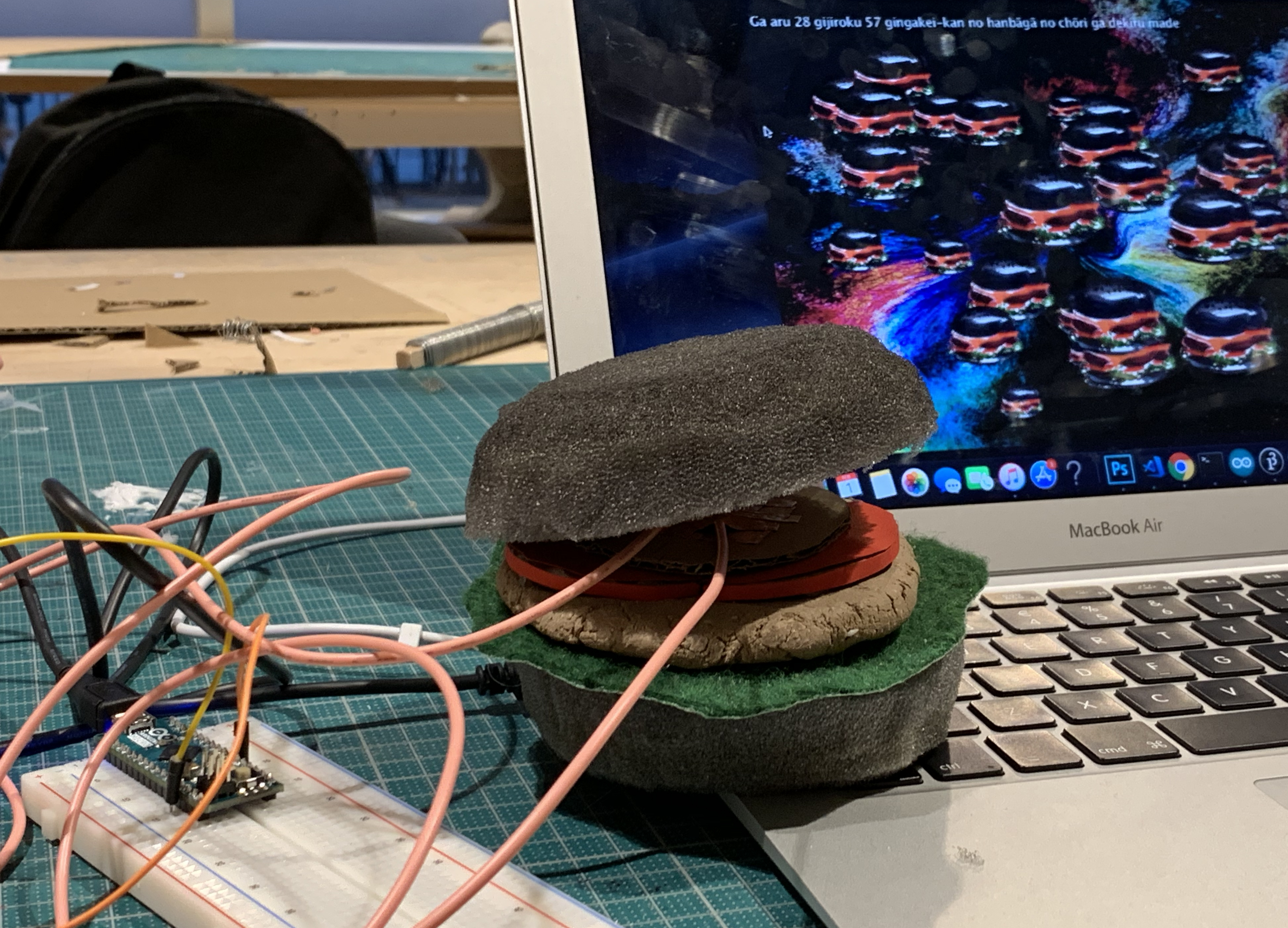
Intergalactic Burger

Group theme: burger

Challenge: build a physical prototyping that will react to a Processing visualisation 

Three hours well spent on how to get more in depth with Processing and David was very helpful in assisting our group with the Processing code. While my team mates were building the physical burger controller, I did took the task of coding. I learned how to load one static image as a background and one float image and afterwards how to code this image as a an array that will react to our controller. It was pretty fun, but our subject was trivial. Therefore, our project resulted in a trivial, only for fun work. 


Introduction to Physical Prototyping


Recently returned from my South America adventure, where I had the chance to discover crafts as a means of creating very beautiful and functional objects, I was surely excited to start the physical prototyping journey. The lecture was mainly about general information over the course, the examination methods and the dates for our not yet announced projects. 

“Design never stops”, our teacher told us and I surely felt that I agree instantly. We do live in a constantly improving society, where we are iteratively trying to solve issues and become the best in our practice. I do feel like it is impossible to reach perfection in design, but I do keep my mind open on the possibility. 

Cat Meat: A first encounter with Arduino and physical prototyping

screenshot 2019-01-28 at 11.17.46

Ever since one of my acquaintances informed me that he started working on a new project consisting of a robotic arm that can hold a video camera and move in synchronisation with a CGI, all of this possible with this innovative piece of hardware called Arduino, I was eager to find out more about what it is all about. 

After a thorough introduction to general information and basic electronics tricks involving the board, Arduino Creator and different cables and buttons, we were given the challenge of the day: create an external controller using only cardboard, copper and connect it to a video game of your choice. I look to my classmate and I confess that I do not even see this possible. 

Me and Weronika team up with a product design student and we try to ideate for a few minutes in the hopes that we will clear out some of the confusion. We decided that our little experiment will be conducted on a funny Super Mario like video game, only that the main character is a cat. 

We chose actions walking forward, walking backwards and jumping and my teammates started cutting out cardboard in different shapes. I had the example from David for how to create a button on the Arduino board so I have edited it to my desired place on the board, copied it two more times and created two additional buttons. I have defined it in the code, creating a button for up key which is the jumping action, one for key right which is for walking forward and key left for walking backwards. We started placing copper on the different shapes and place the cables connected to the board. 

Test time: we were so excited and so curious at the same time if our experiment will actually be successful! We started the game and we started touching the shapes together corresponding to the desired action. Nothing happened, our character was not moving. “You have to touch exactly the two pieces of copper”, Johannes told us. We tried again and the character was now alive. 

I can not possible explain my fascination at the moment, I felt like a small kid in a candy shop. Suddenly I could see all types of interactions coming alive and so many opportunities. It is truly fascinating the way computer science, electronics and simple craft came together and created this little magic trick. But I should realise: there is still so much more to learn!